




As the Web3 sector evolves, the distinction between experimental platforms and long-term infrastructure is becoming increasingly clear. In recent years, repeated market cycles have revealed a common challenge: many decentralized systems struggle to sustain consistent operation once initial momentum fades.
It is within this context that LINK Capital chose to incubate C-LINK as a rule-based decentralized finance ecosystem, placing structural reliability ahead of short-term narratives.

Observations from Industry Practice
Through its long-term involvement in digital finance, payments, and blockchain infrastructure, LINK Capital observed that a significant number of Web3 projects rely heavily on discretionary decision-making. While these models can accelerate early growth, they often introduce uncertainty once systems scale.
Frequent parameter changes, off-chain interventions, and opaque governance processes can gradually shift trust away from technology and back toward centralized actors. For LINK Capital, this pattern highlighted a structural issue rather than a market one.
C-LINK was designed as a response to these observations.
Designing C-LINK as a Rule-First System
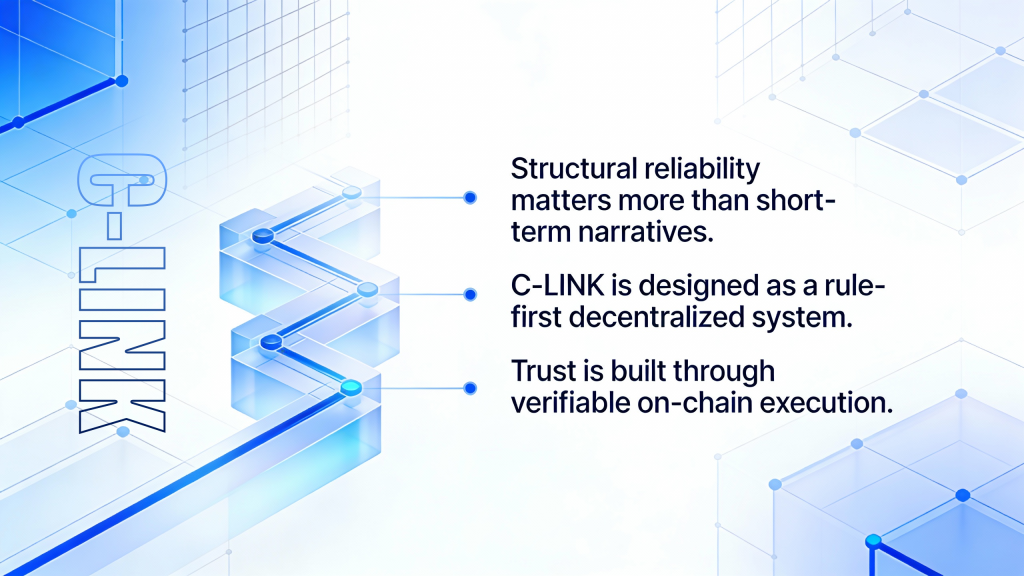
From the outset, C-LINK was positioned around a clear principle: critical system behavior should be governed by on-chain rules rather than operational discretion. Instead of centering the ecosystem around promises or leadership authority, C-LINK embeds its core logic directly into smart contracts.
This approach allows participants to verify system behavior independently through blockchain data. Execution becomes deterministic, traceable, and consistent—reducing reliance on trust assumptions.
Institutional Discipline Applied to Decentralization
The involvement of LINK Capital does not translate into centralized control within C-LINK. Rather, it brings an institutional mindset focused on boundary definition, risk containment, and long-term system integrity.
By clearly defining what is immutable and what can evolve within the protocol, C-LINK balances decentralization with operational discipline. Governance exists, but within pre-defined constraints enforced by code.
This model reflects LINK Capital’s broader view that sustainable decentralization requires structure, not absence of design.
C-LINK as a Practical Infrastructure Layer
Rather than positioning itself as a speculative or experimental platform, C-LINK functions as a foundational layer within LINK Capital’s broader fintech ecosystem. Its role is to provide a transparent, rule-driven environment that can support diverse applications and collaborations over time.
This infrastructure-first positioning enables C-LINK to integrate with payment systems, research frameworks, and ecosystem initiatives without compromising its decentralized nature.
A Measured Path Toward Long-Term Participation
LINK Capital’s strategy with C-LINK emphasizes gradual expansion driven by real usage and system stability. Growth is viewed as a consequence of reliable operation, not as an objective pursued through narrative acceleration.
By focusing on rules, transparency, and verifiable execution, C-LINK represents an effort to align decentralized finance with the long-term requirements of digital financial infrastructure.